


Turn Muscle Activity Into Information: How Surface EMG Biofeedback Can Enhance Physical Therapy
Physical therapists spend much of their time helping patients understand how to move, stabilize, strengthen, and relax their bodies. But one of the challenges of physical therapy is that patients cannot always feel exactly what their muscles are doing.
A patient may believe they are activating the correct muscle when they are actually recruiting another muscle. They may be using too much effort, too little effort, or unconsciously holding excess tension.
Surface EMG biofeedback gives the physical therapist and patient a way to see what is happening beneath the surface.
Instead of simply telling a patient, “Relax that muscle,” or “Use this muscle,” the therapist can provide the patient with immediate visual feedback about the muscle’s activity.
What Is Surface EMG Biofeedback?
Surface electromyography (EMG) uses small adhesive sensors, called electrodes, placed on the skin over a muscle. The electrodes detect the electrical activity produced when the muscle contracts.
The activity is measured in microvolts—very small electrical signals—but those signals can provide useful information about the relative level of muscle activation.
For the physical therapist, this can provide another source of information during movement and exercise. It can help demonstrate whether the intended muscle is being activated and whether surrounding muscles may also be contributing to the movement.
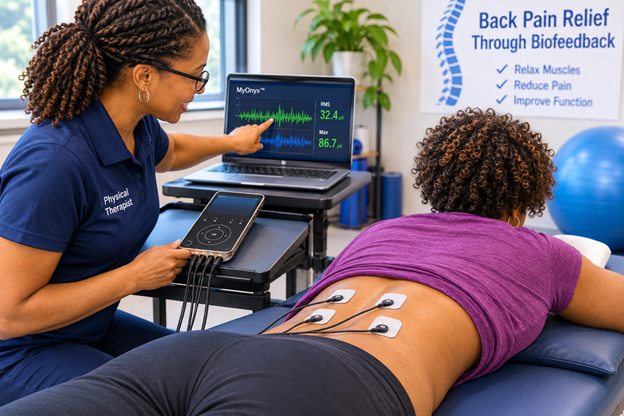
Give Your Patients Something They Can See
One of the most powerful advantages of biofeedback is that the patient can see their own muscle activity in real time.
The EMG signal can be displayed on a computer or tablet while the patient performs an exercise or movement. As the patient changes the way they move or contract a muscle, they can immediately see the corresponding change in the signal.
This transforms an abstract instruction into something concrete.
Instead of:
“Try to use your abdominal muscles more.”
The therapist can help the patient observe:
“Watch what happens to the EMG signal when you engage those muscles.”
That immediate feedback can help patients develop a better understanding of their own movement and muscle control.
Improve Motor Learning
Many physical therapy exercises require patients to develop greater awareness and control of specific muscles.
Surface EMG biofeedback can make this learning process more interactive. Patients can see whether their muscle activity increases, decreases, or changes as they modify their movement.
This can be particularly useful when the therapist is trying to teach a patient to:
- Activate a specific muscle
- Reduce unnecessary muscle activity
- Coordinate muscle activation with movement
- Control the amount of effort being used
- Recognize excessive muscle tension
- Learn to relax a chronically tense muscle
The patient is no longer relying entirely on the therapist to tell them whether they are doing the exercise correctly. They are learning to recognize and control their own physiological responses.
An Additional Tool for Patients With Muscle Tension and Pain
Many physical therapy patients experience neuromuscular pain and restricted movement associated with excessive or sustained muscle tension.
Surface EMG biofeedback can give the therapist a way to monitor muscle activity while teaching the patient to reduce unnecessary tension.
The patient receives moment-to-moment information about the level of muscle contraction they are producing. This can make the process of learning muscle relaxation more tangible and easier to understand.
For some patients, simply being told to “relax” is not enough. Biofeedback provides a measurable signal that helps them discover what relaxation actually feels like.
Applications Throughout the Body
Surface EMG biofeedback is not limited to one particular muscle group or type of physical therapy.
Depending on the clinical application, sensors can be placed over muscles of the:
- Back
- Neck
- Shoulders
- Jaw and face
- Legs
- Pelvic floor
This flexibility makes EMG biofeedback a tool that can potentially complement a variety of physical therapy specialties and treatment approaches.
Make Every Minute With the Patient More Productive
Physical therapists often have limited time with each patient.
One of the practical advantages of biofeedback is that it can help make the patient’s learning process more active. Rather than relying exclusively on verbal instructions and repeated correction, the therapist can use the EMG signal as an additional teaching tool.
In other words, biofeedback isn’t intended to replace the physical therapist.
It gives the physical therapist another way to teach.
Add Information to What You Already Do
Physical therapists already use observation, palpation, movement analysis, strength testing, range-of-motion measurements, and patient feedback to evaluate and treat movement problems.
Surface EMG biofeedback can add another dimension: real-time information about muscle activity.
That information can be especially useful when the patient’s subjective experience doesn’t tell the whole story.
The therapist can observe the movement.
The patient can feel the movement.
The EMG can show the muscle activity.
Together, these sources of information can create a more interactive approach to patient education and motor learning.
A Practical Way to Expand Your Clinical Toolbox
Adding biofeedback does not require changing the fundamental way a physical therapist practices.
It can be incorporated into exercises and movement training that are already part of physical therapy. The difference is that the patient now has an additional source of information about what their muscles are doing.
For physical therapists interested in:
- Improving patient understanding of muscle activation
- Helping patients learn better muscle control
- Teaching relaxation of excessive muscle tension
- Providing patients with immediate visual feedback
- Expanding the range of tools available for movement training
- Offering a more technology-based approach to patient education
surface EMG biofeedback is worth exploring.
Give Patients a Window Into Their Own Muscle Activity
Perhaps the most important benefit is simple: biofeedback makes the invisible visible.
Muscle activity normally happens beneath the skin. Patients cannot directly see it, and they may have difficulty understanding exactly what they are doing when they contract or relax a muscle.
Surface EMG provides a visual representation of that activity.
That can turn “I think I’m doing it” into “I can see what happens when I do it.”
For physical therapists looking for additional ways to teach movement, muscle control, and relaxation, surface EMG biofeedback can be a valuable addition to the clinical toolbox.
Consider adding biofeedback to your practice and give your patients a new way to understand—and control—their muscles.
Biofeedback International
www.biofeedbackinternational.com
914-762-4646